Comparison
Claude vs Gemini: A Head-to-Head Comparison
Claude vs Gemini compared on writing, files, Google Workspace integration, free tiers, context windows, images, and price as of mid 2026.

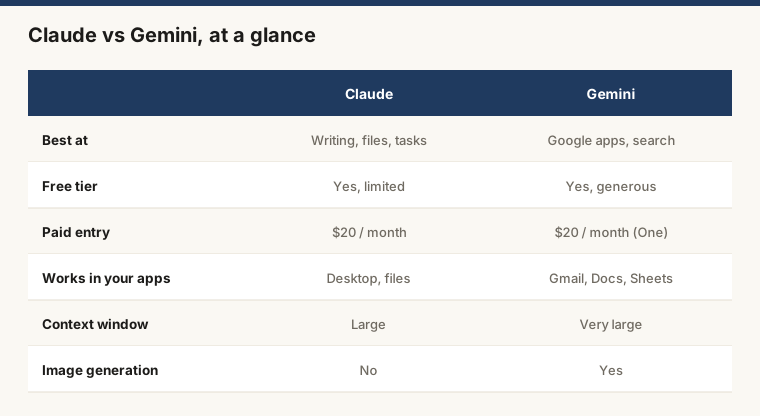
Claude (made by Anthropic, not Google) is stronger for writing and long document work. Gemini is better for Google Workspace users and anything requiring current web search or image generation. Both cost around $20 per month for the paid tier as of mid 2026.
Two AI assistants occupy most of the conversation in 2026 for users who have moved past, or never started with, ChatGPT: Claude and Gemini. They are genuinely different products from different companies built on different model architectures. The comparison below covers the areas where that actually shows up in daily use, rather than in benchmark tables.
Who makes these
This comes up more often than you might expect: Claude is made by Anthropic, an AI safety company founded in 2021 by former OpenAI researchers. Gemini is made by Google DeepMind. They are not related, not interchangeable, and not versions of the same thing. Anthropic does not work for Google. Claude is not a rebranded Gemini. These clarifications are apparently necessary.
Anthropic’s focus on safety and alignment shapes how Claude behaves: it is trained to follow nuanced instructions carefully and to decline requests in a way that is more calibrated than a blanket refusal. Google’s focus with Gemini is integration into its existing product suite and access to real-time information through Google Search.
Writing and instruction-following
Claude is the stronger writer. That is a generalization with exceptions, but it holds across the kinds of tasks most people run: drafting emails, editing long documents, writing copy, summarizing research, generating structured content from messy inputs.
The difference comes down to instruction-following. Claude tends to do exactly what you asked, including honoring constraints you set: word count, tone, format, what to leave out. Gemini is capable but more likely to drift from detailed instructions over a long conversation, or to add structure you did not ask for, a quality that sounds harmless until the model helpfully bolds every subheading in a document that was not supposed to have subheadings.
For anything involving a long document, Claude’s 200,000-token context window is the relevant number. That covers roughly 150,000 words, enough for a full book manuscript, a substantial codebase, or a large reading list in a single session. Gemini’s context window on the paid tier (Gemini 1.5 Pro and above) is also very large, at up to 1 million tokens in some configurations; check Google’s current model documentation for current specs.
For how Claude stacks up against OpenAI specifically, see our Claude vs ChatGPT article.
Google Workspace integration
This is where Gemini has a clear and unambiguous advantage. Gemini is built into Gmail, Docs, Sheets, Drive, and Meet. You can ask it to summarize a long email thread, draft a reply, pull data from a spreadsheet, or turn meeting notes into action items without leaving the app you are already in.
Claude does not have native Google Workspace integration as of mid 2026. You can connect Claude to Workspace through third-party tools and Zapier-style automations, but it is not a built-in experience. “Can be made to work with some configuration” and “is built into the product” are different propositions.
If your organization runs on Google Workspace and that integration matters to your daily workflow, Gemini is the practical choice. If you work primarily outside Google’s ecosystem, the integration advantage is largely irrelevant.
Real-time search and current information
Gemini pulls current information from the web: news, prices, data that postdates its training cutoff. Google Search is the underlying source, which is about the most reliable real-time index available.
Claude does not have native web search in the standard interface as of mid 2026, though Anthropic has been rolling out search capabilities through Claude.ai. Check the Claude.ai feature page for current status.
If you regularly need answers about things happening now, Gemini handles this more reliably. For research that requires inline citations rather than prose summaries, Perplexity is still the stronger dedicated option.
Image generation and vision
Gemini generates images via Google’s Imagen model, available in the paid tier. It also handles image inputs: upload a screenshot or photo and ask questions about it.
Claude handles image inputs but does not generate images as of mid 2026. Anthropic has said image generation is on the roadmap; check the current Claude feature list for updates. “On the roadmap” being the phrase that could mean anything from next quarter to eventually, so treat it accordingly.
If image generation is part of your workflow, Gemini is the choice between these two. If you only need image understanding, both are capable.
Free tiers
Both offer free access. Gemini’s free tier is more generous on daily usage: access to Gemini 1.5 Flash and some Gemini 2.0 features, with fairly high usage limits for a no-cost product.
Claude’s free tier is more rate-limited, particularly during busy periods. If you hit usage limits frequently, Claude Pro at $20/month is the straightforward fix.
Neither company publishes exact token limits on free tiers, and both adjust them periodically. If you are evaluating which free tier lasts longer before you hit a wall, the only reliable method is testing both on your actual workload.
Paid pricing
Both individual paid tiers sit at roughly $20/month as of mid 2026:
- Claude Pro: $20/month (Anthropic pricing page)
- Gemini Advanced: $19.99/month, bundled with 2 TB of Google One storage (Google One pricing)
For teams and enterprises, both have higher-tier plans with volume pricing, admin controls, and data privacy agreements. Pricing at that level changes frequently enough that requesting a quote directly is more useful than any figures published here.
Coding
Both models handle code generation well. Claude is particularly strong at following precise coding instructions across a long session without losing track of what was established earlier. Gemini’s code output is competent and benefits from its access to current documentation via search, which matters when the library you are using updated its API last month.
For developers, the practical test is whether the model can hold coherent state across a multi-file refactor or a lengthy debugging session. Claude’s larger effective context tends to help here, though Gemini 1.5 Pro’s extended context is competitive at the paid tier.
Side-by-side summary
| Category | Claude | Gemini |
|---|---|---|
| Writing quality | Stronger | Competitive |
| Long documents | 200K tokens | Up to 1M tokens (paid) |
| Google Workspace | No native integration | Built-in |
| Real-time search | Limited / in progress | Yes, via Google Search |
| Image generation | No | Yes (Imagen) |
| Image understanding | Yes | Yes |
| Free tier | Rate-limited | More generous |
| Paid price | $20/mo | $19.99/mo |
Which one
For writers, editors, and anyone whose primary use is long-form text and document work, Claude is the better fit. For Google Workspace users who want AI built into the apps they already use, Gemini is the practical answer.
The two are close enough on general tasks that you will not feel shortchanged by either. For six options side by side, including the ones beyond these two: the best ChatGPT alternatives.
Frequently asked questions
Is Claude actually better than Gemini?
Claude is generally rated higher for writing quality and instruction-following on long documents. Gemini is better for real-time information, Google Workspace integration, and image generation. Which is 'better' depends on what you are doing with it.
Is Claude owned by Gemini?
No. Claude is made by Anthropic, an AI safety company founded in 2021. Gemini is made by Google. They are completely separate companies and separate model families with no ownership relationship.