Guide
The Best ChatGPT Alternatives in 2026
A ranked guide to the best ChatGPT alternatives in 2026, from Claude and Gemini to Perplexity, Copilot, and open models like Llama and DeepSeek.

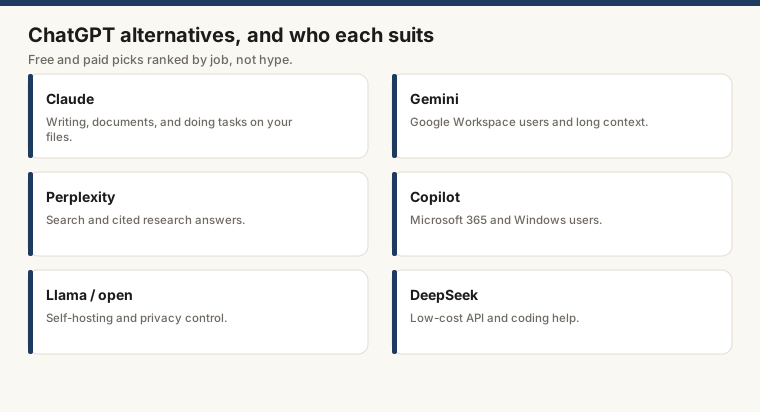
The strongest ChatGPT alternatives in 2026 are Claude for writing and tasks, Gemini for Google Workspace users, Perplexity for cited search, Microsoft Copilot for Microsoft 365, Llama for self-hosting, and DeepSeek for low-cost API work.
ChatGPT is not the only option. In several categories, it is not even the best one. The alternatives below each have a specific strength; the right pick depends on what you are actually doing with the tool.
Why shop around
OpenAI’s GPT-4o is a capable general-purpose model. The competition has also closed the gap significantly over the past 18 months, which the marketing from every AI company is happy to tell you about in the most self-serving possible terms. Some alternatives are cheaper. Some handle long documents better. Some are built into tools you already use. The options below are ranked on practical utility as of mid 2026, not benchmark scores, because benchmarks have a way of being optimized for rather than actually reflected in real use.
Prices and feature sets change often. Check the vendor’s current pricing page before committing.
1. Claude (Anthropic)
Claude is the strongest general-purpose alternative to ChatGPT. Made by Anthropic, it runs on a separate model family (not GPT), with a focus on safety and instruction-following.
Where it wins: long documents. Claude’s context window currently supports up to 200,000 tokens, which lets you load an entire contract, codebase, or research paper and ask questions that require synthesizing across the whole thing. It is also notably good at following detailed, multi-step instructions without drifting partway through.
For writing, Claude is the model most editors and content teams reach for first. Its outputs are cleaner out of the box, with less of the padding and filler that GPT-4o sometimes produces. The full breakdown is in our Claude vs ChatGPT comparison.
For agentic work, running multi-step tasks autonomously, using tools, browsing the web, Claude’s tool-use support is solid and improving. Anthropic’s Claude.ai app has an “extended thinking” mode for harder reasoning tasks where the model works through the problem before committing to an answer.
Free tier: yes, with rate limits. Paid plan (Claude Pro): $20/month as of mid 2026.
Good for: writers, researchers, developers, anyone who regularly works with long files.
2. Gemini (Google)
Google Gemini is the natural choice if you spend most of your day in Google Workspace. Gemini integrates directly with Gmail, Docs, Sheets, and Drive, which makes it more useful than a standalone chat window for the kind of office work that lives inside those apps.
On raw writing quality, Gemini 1.5 Pro and the newer Gemini 2.x models are competitive with GPT-4o on most tasks. Where Gemini has a clear edge is real-time search: it pulls current information from the web, which ChatGPT does less reliably, and which Claude does not do natively.
Gemini generates images via the integrated Imagen model. Claude does not generate images as of mid 2026.
Free tier: generous. The free version includes access to Gemini 1.5 Flash and some Gemini 2.0 features. Gemini Advanced (the paid tier) runs $19.99/month and bundles 2 TB of Google One storage.
Good for: Google Workspace users, anyone who needs current information, image work.
3. Perplexity
Perplexity is not a general-purpose chatbot. It is a search engine that answers in prose and cites its sources inline. That distinction matters more than it sounds.
For research, Perplexity is the model to beat. Every answer links to primary sources, and the inline citations make verification straightforward rather than a separate project. For the kind of question where you would normally run several Google searches, open multiple tabs, and synthesize the results yourself, Perplexity compresses that into one step. It is not the right tool for creative writing, coding, or long document analysis. But for “what is the current state of X,” it is faster and more trustworthy than asking a model without search.
Free tier: yes. Perplexity Pro runs $20/month and unlocks access to more powerful underlying models, including GPT-4o and Claude.
Good for: research, fact-checking, current events.
4. Microsoft Copilot
Microsoft Copilot is powered by GPT-4o (Microsoft has a partnership with OpenAI), so the underlying model is close to ChatGPT. The difference is where it lives: built into Windows 11, Microsoft 365 (Word, Excel, Outlook, Teams), and Edge.
If your organization runs Microsoft 365, Copilot for Microsoft 365 (the enterprise add-on, priced separately) can draft emails from meeting notes, summarize long threads, generate formulas in Excel from plain-language descriptions, and produce first drafts in Word. The workflow integration is the actual value proposition. The model underneath is not meaningfully different from ChatGPT.
Free tier: yes, Copilot.microsoft.com is free with a Microsoft account. The Microsoft 365 Copilot add-on is priced at the organization level; check Microsoft’s current pricing for current rates.
Good for: Microsoft 365 users, enterprise teams.
5. Llama and other open models (self-hosting)
Meta’s Llama series is the most widely used open-weight model family. “Open-weight” means the model weights are publicly available; you can download and run them on your own hardware, with no data leaving your machine.
That matters for privacy-sensitive work. A law firm that cannot send client documents to a third-party API can run Llama locally. A developer who wants to fine-tune a model on proprietary data can do it with Llama.
The tradeoff is setup complexity and hardware cost. Running a capable Llama 3 70B model requires significant GPU memory (typically 40 GB or more for comfortable inference). Smaller models like Llama 3 8B run on consumer hardware but give noticeably weaker results on complex tasks. For teams that want local inference without building the full stack, Ollama and LM Studio make local model serving reasonably accessible.
Good for: privacy-sensitive use cases, developers who want full control, organizations that cannot route data through cloud AI.
6. DeepSeek
DeepSeek is a Chinese AI lab that released a series of models in late 2024 and early 2025, drawing attention primarily for their cost. DeepSeek V3 and R1 performed close to GPT-4-class models on several benchmarks while costing a fraction of GPT-4o at the API level.
For developers building applications that call an LLM API at volume, DeepSeek is worth evaluating on cost alone. The R1 model performs well on reasoning and math tasks specifically.
Two considerations to weigh before committing: DeepSeek is based in China, which raises data-sovereignty questions for some organizations. The models’ safety documentation is also less extensive than OpenAI’s or Anthropic’s. If those factors are relevant to your use case, account for them before you commit. Current API pricing is at DeepSeek’s platform page. For the full cost and privacy breakdown, see our dedicated DeepSeek vs ChatGPT comparison.
Good for: developers building API-based applications, cost-sensitive workloads, math and reasoning tasks.
How they compare at a glance
| Model | Best for | Free tier | Paid (approx.) |
|---|---|---|---|
| Claude | Writing, long docs, agentic tasks | Yes | $20/mo |
| Gemini | Google Workspace, images, search | Yes (generous) | $20/mo |
| Perplexity | Cited research, current info | Yes | $20/mo |
| Copilot | Microsoft 365 integration | Yes | Enterprise pricing |
| Llama | Self-hosting, privacy | Free (run yourself) | Hardware cost |
| DeepSeek | Low-cost API, reasoning | Yes (API credits) | Very low per-token |
Which one should you use
If you are replacing ChatGPT for general everyday use, Claude is the place to start. If you are already inside Google’s ecosystem, Gemini fits more naturally. If your primary use case is research, Perplexity handles that job better than either of them. If you want the cheapest capable API and real-time X data, our Grok vs ChatGPT breakdown covers what changed with the Grok 4.5 launch.
For a direct comparison of the two strongest general-purpose options: Claude vs Gemini.
Frequently asked questions
Which AI is better than ChatGPT?
It depends on the job. Claude is widely regarded as the best for long-form writing and agentic tasks. Perplexity is better for research that needs citations. Gemini is better if you live in Google Workspace. No single model beats ChatGPT at everything.
What can I replace ChatGPT with?
For most general use, Claude (claude.ai) is the closest replacement with a comparable free tier and a $20/month Pro plan. Perplexity works well for anything research-heavy. Microsoft Copilot is the natural swap if you use Microsoft 365.
Is ChatGPT still the best AI?
As of mid 2026, ChatGPT is still the most-used AI assistant, but it is no longer the clear leader on quality benchmarks. Claude, Gemini, and Perplexity each outperform it in specific categories. Check the current LMSYS Chatbot Arena leaderboard for up-to-date rankings.